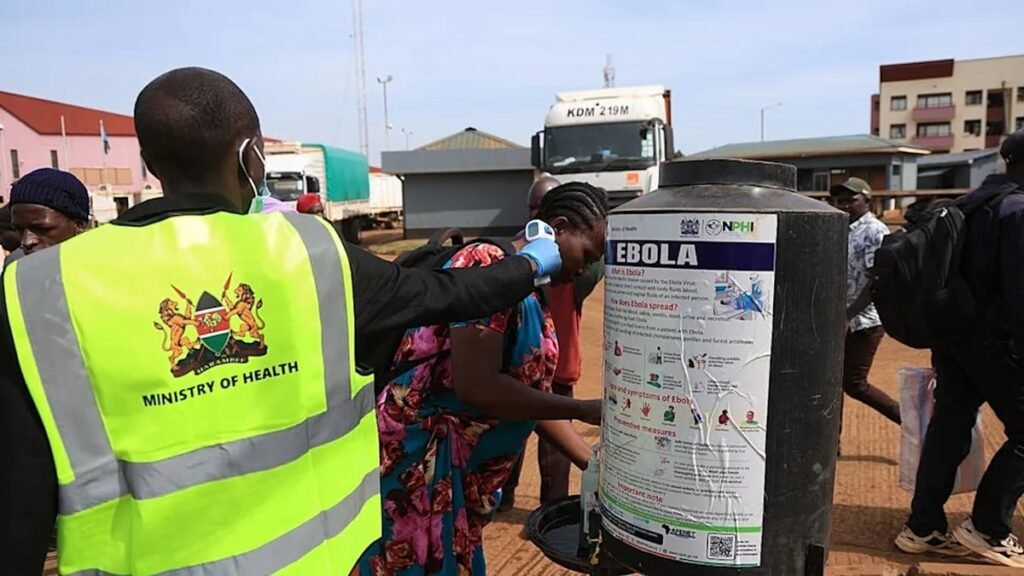
Kenya confirmed its eighth Ebola case on Sunday, Oct. 18, after a man already in quarantine as a contact of the country’s first patient tested positive.
Director-General for Health Patrick Amoth said the Ministry of Health tested 38 people on Sunday and one was positive. “Not a direct health care worker, a 49-year-old gentleman who developed symptoms of fever, headache, and muscle pain, and his test came out positive,” Amoth told Citizen TV.
The man worked as a patient attendant, cleaning utensils and linens, and was probably exposed to the first patient, Reuters reported.
All eight cases are linked to the first patient, health officials said. The six people who tested positive before him are in isolation, ABC News reported.
How the virus reached Kenya
The first patient, a Kenyan man, traveled by road from the Democratic Republic of Congo to Kampala, Uganda, and flew to Nairobi on Oct. 3, according to the World Health Organization. He died on the night of Oct. 5 and was the first Ebola case ever recorded in Kenya.
Health teams identified 130 people who had been in contact with him, including relatives, friends, health workers who treated him and passengers on his flight. Of those, 128 have been traced and placed in quarantine, the Ministry of Health said.
The second and third cases, confirmed Oct. 14 and Oct. 16, were close family members of the first patient, WHO said. It reported that the second patient was stable and responding to supportive care.
No vaccine for this strain
The infections involve Bundibugyo virus, one of the viruses that cause Ebola disease. There is no licensed vaccine or specific treatment for Bundibugyo Ebola, although trials are under way in Congo, WHO said in an Oct. 16 update.
Early care improves a patient’s chances of survival, according to WHO. That includes fluids to prevent dehydration and treatment of specific symptoms.
Ebola spreads through direct contact with the blood or body fluids of a person who is sick with or has died from the disease, or with contaminated objects. It does not spread through the air, and people are not contagious before symptoms appear, WHO says.
Congo’s outbreak widens
In Congo, the government announced Sunday that the virus had reached North Ubangi, the eighth province affected, Al Jazeera reported.
In Kenya, health teams are monitoring contacts for 21 days, the longest time between infection and the first symptoms.