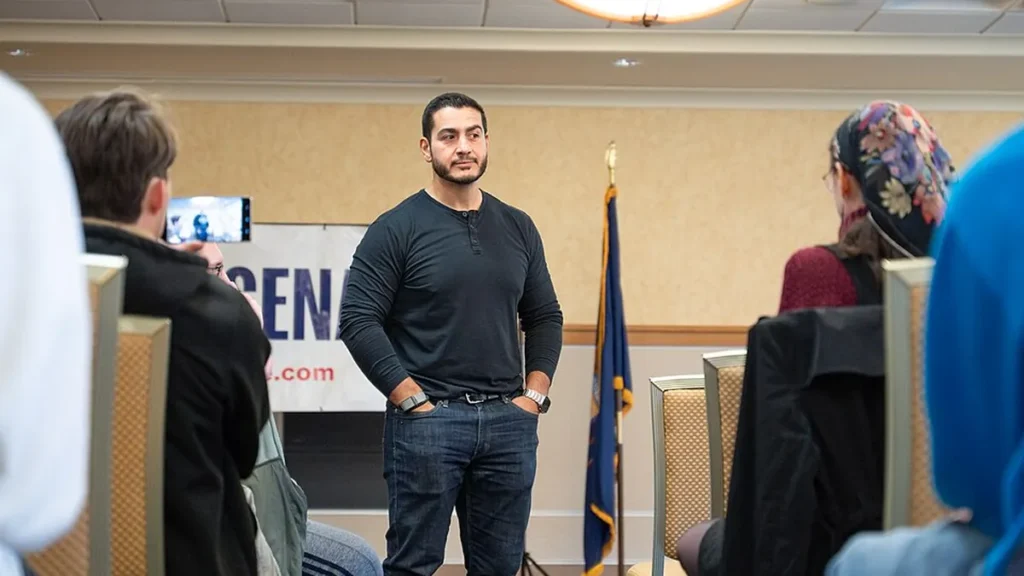
Michigan Democratic Senate nominee Abdul El-Sayed and his former primary rival, Rep. Haley Stevens, have reopened their public feud over Israel and a political ad, upending a planned show of party unity days before the Nov. 3 election.
On Friday, Stevens demanded that El-Sayed condemn an ad by Rebellion PAC, a group linked to commentator Cenk Uygur, that tied U.S. military aid to Israel to high grocery prices. “We are not going to say that the cost of groceries is because of Jews and the Jewish state,” Stevens told The New York Times.
“A disclaimer is not a condemnation,” Stevens said in a statement carried by the Michigan Advance.
Abdul El-Sayed responds
El-Sayed’s campaign has said the ad was “not affiliated in any way” with his campaign, according to Newsweek. In his reply to Stevens, El-Sayed accused her of “relitigating a primary that ended three months ago” instead of focusing on defeating Republican nominee Mike Rogers.
The clash put a planned Sunday appearance in doubt. Stevens had agreed to join El-Sayed at a Detroit church event with Rep. Jim Clyburn of South Carolina.
By Saturday, El-Sayed’s campaign had dropped Stevens’ name from the event’s description, which now lists Clyburn and Sen. Angela Alsobrooks of Maryland. His campaign also asked Stevens to stay away from its remaining events, USA Today reported.
Stevens narrowly lost the Democratic primary in August and later endorsed El-Sayed. She said Wednesday that she still planned to vote for him, even after her fiance, Jason Turkish, said he would vote for Rogers.
She has also urged El-Sayed to pull a campaign ad that uses a clip of commentator Tucker Carlson saying he would not vote for Rogers.
Rogers has seized on the feud to court Jewish voters who backed Stevens in the primary. No Republican has won a U.S. Senate race in Michigan since 1994.